Green and Yellow LED Light: What We Know So Far
Green light (520 nm) and the yellow mode (630 + 520 nm) are colours that fit easily into an evening routine. See what the research says about them and how to rotate them through the week.

Updated: November 2026 · Marek Švajka · 7 min read
Green light in an LED face mask has a wavelength of around 520 nm and is chosen in cosmetic care that focuses on a more even-looking skin tone. The yellow mode is created by combining red (630 nm) and green (520 nm) light and is the one to reach for when skin looks tired. Research into both colours keeps growing.
In brief
- The green mode of the LumenLuxe LED mask emits 520 nm; the yellow mode combines 630 nm and 520 nm.
- Both colours fit well into a calm evening routine and can be rotated with the other modes.
- A 2024 review summarised 9 studies on how light affects tyrosinase at 630, 585/590 and 830/850 nm; research on green LED is still limited.
- One session takes 10 minutes and the recommended frequency is 3–5 times a week.
- Daily SPF remains the foundation of caring for skin tone.

What is green LED light and what wavelength does it have?
Green LED light is visible light with a wavelength of roughly 495–570 nm; in the LumenLuxe LED mask the green mode emits 520 nm. In the spectrum it sits between blue (460 nm) and red (630 nm) light. It is visible light – UV radiation only begins below the 400 nm mark.
In cosmetic care, green is associated with skin tone. People choose it when they want their skin to look more even and calm, and when they want to add another colour to their evening routine. We look at how skin tone and dark spots relate to light in the article Skin pigmentation and the LED mask.
Why is light described in nanometres?
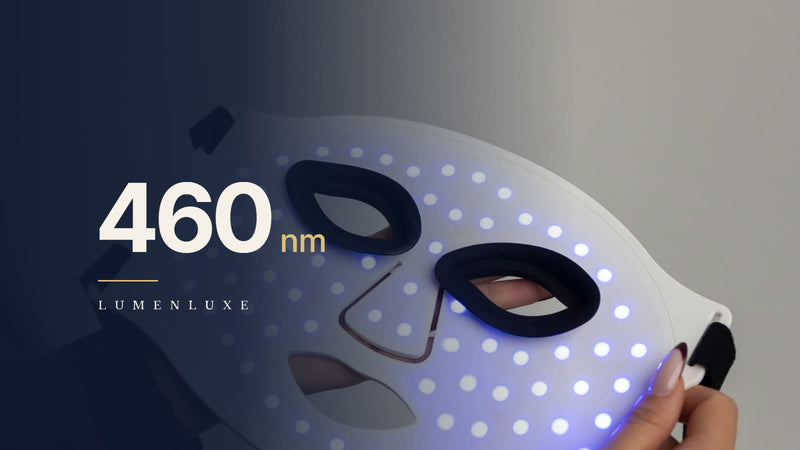
A nanometre (nm) is a unit of wavelength and determines which colour of light we see. A difference of a few dozen nanometres means a different colour, which is why it helps when a manufacturer states the exact figure for every mode. For the LumenLuxe LED mask there are three core values: 630 nm, 520 nm and 460 nm.
What is yellow LED light and how is the yellow mode created?
We perceive light as yellow at wavelengths of roughly 570–590 nm; in the LumenLuxe LED mask the yellow mode is created when the red diodes (630 nm) and the green diodes (520 nm) shine at the same time. The eye reads this pairing as a warm yellow light. During a single session the skin therefore receives both wavelengths together.
The other combined modes work on the same principle: cyan (520 + 460 nm), purple (630 + 460 nm) and white (630 + 520 + 460 nm). Three core colours thus give seven modes, and you choose between them according to what your skin needs that evening. All the colours are compared side by side in LED mask colours: which of the 7 modes to use when.
What does the research say about green and yellow light?
Research so far has focused mainly on red light; there are fewer studies on yellow and green, so we read their conclusions carefully and without exaggeration. The most complete view of light and skin tone comes from an integrative review by Galache, Sena, Tassinary and Pavani published in 2024 (Photodermatol Photoimmunol Photomed 2024;40(1):e12935).
What did the 2024 review summarise?
The authors covered 9 studies, including laboratory and animal studies. They were interested in the influence of photobiomodulation on tyrosinase – an enzyme involved in producing melanin, the pigment of the skin. They described an influence at wavelengths of 630 nm, 585/590 nm and 830/850 nm, with doses in the summarised papers ranging from 1 to 20 J/cm². It is an integrative rather than a systematic review, so it shows the direction of research, not a final answer.
The cited studies tested other devices and wavelengths; their results are not the results of the LumenLuxe mask.
And what about green light?
Green light around 520 nm is not among the wavelengths summarised in that review, and research on green LED is still limited. We therefore describe the green mode factually: as a pleasant part of a cosmetic routine focused on the look of skin tone. When it comes to hyperpigmentation and dark spots, the most important step is always consistent sun protection.
When should you choose the green mode and when the yellow one?
Choose the green mode on evenings when your routine focuses on a more even-looking skin tone, and the yellow mode when skin looks tired and you want to give it red and green light at once. The table shows how the two modes differ and where they sit among the other colours.
| Mode | LumenLuxe LED mask | How the light is created | When to reach for it |
|---|---|---|---|
| Green | ✓ 520 nm | Green diodes shine | An evening focused on a more even-looking skin tone |
| Yellow | ✓ 630 + 520 nm | Red and green diodes shine together | Skin looks tired and lacks radiance |
| Red | ✓ 630 nm | Red diodes shine | A routine focused on the look of fine lines and firmness |
| White | ✓ 630 + 520 + 460 nm | All three colours shine together | An all-round evening when you would rather not choose |
How do you fit green and yellow light into a weekly routine?
The simplest approach is to rotate the modes by day: one session takes 10 minutes and the recommended frequency is 3–5 times a week. The steps are the same for every colour.
- Cleanse and dry the skin. The light should reach clean skin without make-up.
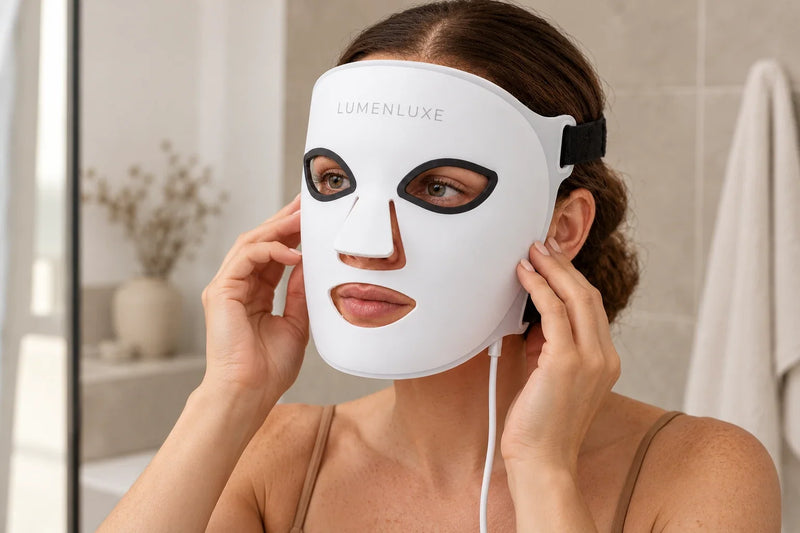
- Put the mask on and place the eye shields. Select the green or yellow mode and one of the 5 intensity levels.
- Relax for 10 minutes. The mask switches off automatically when the session ends.
- Finish the routine. Apply a serum and a moisturiser; remember SPF in the morning.
A sample week with four sessions
| Day | Mode | Focus of the evening |
|---|---|---|
| Monday | Red (630 nm) | The look of fine lines and firmness |
| Wednesday | Green (520 nm) | A more even-looking skin tone |
| Friday | Yellow (630 + 520 nm) | A fresh look after a demanding week |
| Sunday | White (630 + 520 + 460 nm) | All-round care |
Treat the schedule as inspiration – feel free to change the order of the colours. Regularity matters more than any particular combination: short sessions that you come back to every week. The pace of change is individual, so it is worth photographing your skin from time to time in the same light and from the same angle.
What should you keep in mind before the first use?
The green and yellow modes follow the same guidance as all LED masks. Do not use an LED mask during pregnancy, with light-sensitive epilepsy, with retinal conditions or while taking photosensitising medication; keep retinol and acids for a different time of day, and do a short patch test on the skin of your hand before the first use. The full list is in the article LED mask contraindications.
The LumenLuxe LED mask at a glance
CE · RoHS7 modes
The green and yellow modes come in one mask together with five more colours, so every evening you can tailor the routine to what your skin needs.
| Green mode | 520 nm |
| Yellow mode | 630 + 520 nm |
| Other modes | red 630 nm, blue 460 nm, purple 630 + 460 nm, cyan 520 + 460 nm, white 630 + 520 + 460 nm |
| Number of diodes | 210 |
| Output | 20 mW/cm² (≈ 12 J/cm² in 10 min at maximum intensity), 5 intensity levels |
| Session | 10 minutes, 3–5 times a week |
| Certification | CE and RoHS |
| Returns and warranty | 60-day returns, 24-month warranty |
| Price | €199.97 |
BENEFITS
- ✓ Seven modes including green and yellow – rotate colours to match your weekly plan
- ✓ Clearly stated wavelengths and an output of 20 mW/cm² with 5 intensity levels
- ✓ Automatic switch-off after 10 minutes – no need to watch the clock
- ✓ Cordless, USB-C charging, around 10 sessions per charge
- ✓ Eye shields and a storage bag included in the box
- ✓ 24-month warranty and 60-day returns
Frequently asked questions
What is green light in an LED mask for?
Green light (520 nm in the LumenLuxe LED mask) is chosen in cosmetic routines focused on a more even-looking skin tone. Research on green LED is still limited, which is why we describe it as part of cosmetic care. It is used like the other modes: 10 minutes on clean skin.
How is yellow light created in an LED mask?
In the LumenLuxe LED mask the yellow mode is created by the red diodes (630 nm) and the green diodes (520 nm) shining at the same time. The eye perceives this combination as a warm yellow light. During one session the skin receives both wavelengths together.
How often should the green or yellow mode be used?
The recommended frequency is 3–5 sessions a week, each lasting 10 minutes. That number covers all modes together, so green and yellow can be rotated with red or white. The mask switches off automatically when the session ends.
Can green and yellow light be alternated with red?
Yes, the modes can be rotated freely through the week. A practical approach is to give each colour its own day, for example red on Monday, green on Wednesday and yellow on Friday. A plan like this is easy to keep and adds variety to the routine.
What is the foundation of caring for skin tone?
The foundation is daily sun protection with a sufficient SPF, including in winter and on overcast days. An LED mask is an addition to a cosmetic routine, used in the evening on clean skin. If a new or changing spot appears on the skin, show it to a dermatologist.
Does green or yellow LED light contain UV radiation?
No. Green light at 520 nm and red light at 630 nm both belong to the visible spectrum, whereas UV radiation only begins below the 400 nm mark. Keep your eyes closed during the session and use the eye shields provided.
Summary: which mode should you choose?
Green light (520 nm) suits evenings focused on a more even-looking skin tone, and the yellow mode (630 + 520 nm) suits days when skin looks tired. Research into these colours is growing, and the 2024 review shows that light and pigment is a topic scientists care about. The best approach is to build a simple weekly plan from the colours and stick to it. All seven modes, 210 diodes and a 10-minute session with automatic switch-off come together in the LumenLuxe LED mask.